
Houses talk. A door that used to close cleanly starts catching on the frame. A hallway develops a dip you feel with bare feet. A hairline appears above a doorway, gets patched, and shows up again eight months later.
Individually, none of that necessarily means trouble. Foundation problems in DFW rarely announce themselves all at once, and every house in Dallas and Fort Worth shifts a little, because the clay soil under it swells with rain and shrinks in the heat. What separates a settled older home from one with a real problem is the pattern: how many signs there are, whether they are getting worse, and whether they show up together.
This guide covers the signs your foundation needs repair, inside and out, and sorts them by urgency so you know the difference between something to handle now and something to write down and check again in the spring.
Three Levels of Urgency
Before the list, here is the framework worth keeping in mind.
Urgent. Call someone within the next week or two. These signs indicate active movement or structural stress that gets more expensive the longer it runs.
Worth monitoring. Document it, take a photo, check again in a few months. Many of these turn out to be old movements that have already stopped.
Usually cosmetic. Normal material behavior in a Texas house. Note it and move on.
Almost nothing on this list requires panic. Foundation movement happens over years, not overnight, and the houses that end up with expensive repairs are usually the ones where someone noticed a sign in 2019 and never followed up.
Interior Signs
Doors and windows that stick
This is the sign homeowners notice first, and it is one of the more reliable ones. Sticking doors and foundation movement are connected for a simple reason: when a foundation shifts, the walls above it rack slightly out of square, and the door frame goes with it. The door itself has not changed shape. The opening has.
Watch for doors that catch at the top corner, doors that will not latch without a shove, doors that swing open or closed on their own, and windows that used to slide easily and now fight you.
One important caveat for North Texas: humidity swells wood. A door that sticks in July and works fine in November is responding to weather, not your foundation. A door that has been sticking for a year straight, or that gets progressively harder to close season over season, is telling you something different.
Urgency: worth monitoring on its own. Urgent if several doors across different parts of the house are affected at once.
Gaps at the top of a door frame
Look at the gap between a closed door and the frame above it. It should be even across the width. If it is noticeably wider on one side than the other, the frame is out of square, and that is a more specific indicator than simple sticking.
Urgency: worth monitoring, and stronger evidence than sticking alone.
Cracks in walls and ceilings
Interior cracks are extremely common in DFW homes. The location and pattern matter far more than the presence of a crack.
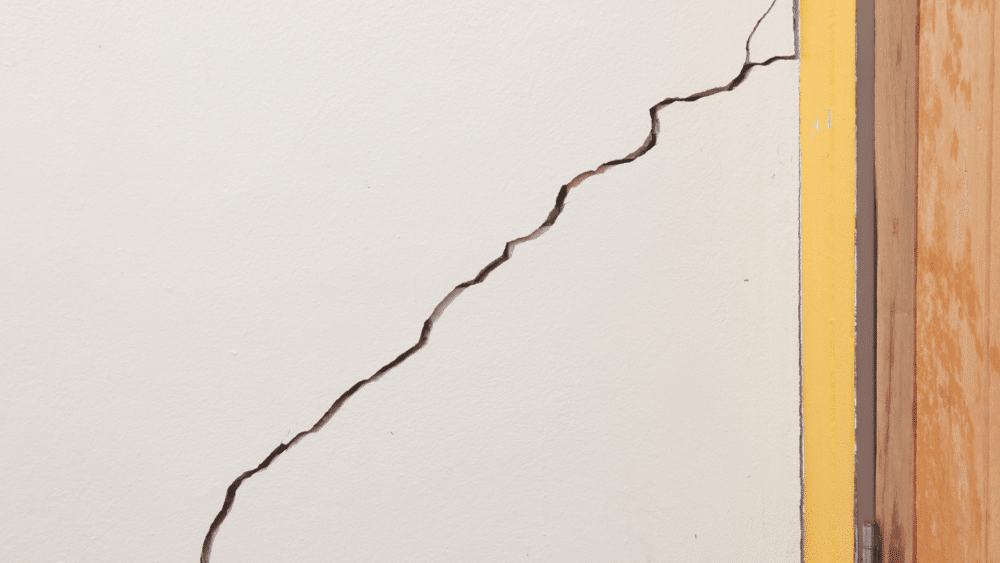
Hairline cracks along drywall seams and small cracks above doorways in a newer house are usually normal settling. Cracks running diagonally from the corners of doors and windows suggest differential settlement, meaning one section of foundation dropped relative to another. Cracks that travel across a ceiling and continue down a wall are more significant. So are cracks that reopen every time you patch them, because that repetition means the underlying movement never stopped.
Our full guide on which foundation cracks are normal and which signal a problem breaks this down by crack type.
Urgency: usually cosmetic for hairlines. Worth monitoring for diagonal cracks. Urgent for any horizontal crack in a foundation wall or a crack wider than a quarter inch.
Gaps between walls and ceilings, or baseboards and floors
Crown molding pulling away from the ceiling. A visible gap opening between the baseboard and the floor. A corner where two walls no longer meet cleanly.
These matter because they indicate separation rather than cracking. The house is pulling apart at the joints, which means parts of the structure are moving in different directions.
Urgency: worth monitoring if small and stable. Urgent if the gap is widening or wide enough to see from across the room.
Sloping, bouncy or soft floors
Sloping floors in Texas homes are a classic sign, especially in pier and beam houses, which many older properties in Fort Worth, Oak Cliff and Arlington have. As piers settle or wood supports weaken, the floor above follows.
A simple test: set a ball or a marble on the floor in a few rooms. Some slope is normal in an older house. A ball that rolls briskly and consistently in the same direction is not.
Bouncy or soft spots are a different signal. In a pier and beam home, that usually points to a weakened joist or beam underneath, often from moisture and rot. Sagging floors tend to appear well before anything cracks.
Urgency: worth monitoring for gentle slope. Urgent for soft or spongy spots, which indicate compromised wood rather than just settlement.
Nail pops and uneven surfaces
Drywall nails or screws backing out of the wall in several rooms, countertops that no longer read level, or cabinets pulling slightly away from the wall.
One nail pop is nothing. A dozen across multiple walls in a year is a pattern.
Urgency: worth monitoring.
Exterior Signs
Cracks in brick and mortar
Stair step cracks following the mortar joints up a brick wall are the most recognizable exterior sign of settlement in a Texas home. A few hairline steps in one small area may be old and stable. Cracking wider than a quarter inch, running a long stretch of wall, or appearing near the corners of the house deserves attention. Corners tend to move first.
Also look at whether the brick on either side of a crack still lines up flat. If one side has shifted forward or back so the wall no longer sits in a single plane, that is more serious than the crack width alone suggests.
Urgency: worth monitoring for hairlines. Urgent for wide cracking or misalignment.
Soil pulling away from the foundation
After a North Texas summer, you may find a gap between the soil and the concrete around your house. A quarter inch is routine. A gap you could slide your hand into means the clay shrank significantly and that section of foundation lost support.
Pay attention to whether it is even all the way around. One side with a dramatic gap and another with none points to uneven moisture, which is the condition that actually causes movement. Consistent foundation watering is the main defense.
Urgency: worth monitoring, and a prompt to fix your watering and drainage.
Chimney separating from the house
A chimney separating from the house, leaning or tilting, or showing a visible gap where it meets the exterior wall, is one of the clearer signs of foundation movement. Chimneys are heavy and often sit on their own footing, so they can settle at a different rate than the rest of the house.
Check by standing back from the house and sighting along the chimney against a vertical reference like a door frame or the corner of the house.
Urgency: urgent. A separating chimney is both a structural and a safety concern.
Bowing or bulging walls
Bowing walls signal foundation stress of a different kind than settlement. A wall that curves inward or outward rather than running straight indicates lateral pressure, meaning soil is pushing sideways against the structure. Sight along the wall from one end to see it, since bowing is hard to notice head on.
Urgency: urgent. Bowing accompanied by a horizontal crack especially so.
Porch, steps, or trim pulling away
Concrete porches, front steps, and attached slabs frequently settle at a different rate than the main house because they sit on separately compacted soil. A gap of a half inch between a porch and the house is common and often not structural.
What matters more is whether the main structure is affected: exterior trim separating at the corners, siding pulling apart, or the garage door no longer meeting the ground evenly across its width.
Urgency: usually cosmetic for a porch gap alone. Worth monitoring if trim and siding are separating too.
Doors and windows out of square from outside
Step back and look at the frames from the yard. Window and door openings should read as clean rectangles. Visible tilt or a frame that looks like a parallelogram indicates the wall has racked.
Urgency: worth monitoring, urgent if paired with sticking doors and interior cracking.
What Makes Signs Add Up to a Real Problem
Three factors turn a list of observations into a clear picture.
Quantity. One sticking door in August means little. Three sticking doors, a diagonal crack over the dining room window, and a sloping hallway is a pattern.
Progression. A crack that has looked the same for six years is history. A crack that has widened since spring is current. This is why documenting matters: mark the ends of a crack with a pencil, note the date, photograph it with a coin for scale, and check again in six months.
Location clustering. Signs concentrated on one side or one corner of the house point toward localized settlement in that area, which is more actionable than scattered symptoms.
When to Call Rather Than Watch
Reach out promptly if you see any of the following:
- A chimney leaning or separating from the house
- Any wall that bows or bulges
- A horizontal crack in a foundation wall
- Cracks wider than a quarter inch in brick or concrete
- Soft or spongy spots in the floor
- Doors or windows that will not close at all
- Multiple signs appearing or worsening within a single year
- You are buying or selling and want documentation before it becomes a negotiating point
Everything else on this page can generally be documented and rechecked in a few months. Our overview of the signs of foundation issues covers additional indicators, and our page on foundation settlement explains how movement progresses when the cause is left alone.

Get a Straight Answer
An inspection is not a commitment to repair, and a good one should be willing to tell you nothing is wrong. Many DFW homes have settled, stopped, and been stable for decades.
If your house is showing signs you cannot make sense of, schedule a free estimate with HD Foundations. Our evaluations take under an hour and cost nothing. If repair is needed, our work carries a lifetime transferable warranty that passes to the next owner, and financing is available.
Call 817-226-7221 or request your evaluation online. We serve homeowners across the DFW metroplex, including Dallas, Fort Worth, Arlington, Irving, Plano, Frisco and Mansfield.