
Almost every house in Dallas and Fort Worth has a foundation crack somewhere. Walk the perimeter of any home built more than a decade ago and you will find something: a line in the mortar, a hairline running up the garage slab, a seam above a doorway that keeps coming back after you paint it.
That is not a crisis. Most foundation cracks in North Texas are cosmetic. But some are the first visible evidence of real movement, and the difference between the two is not obvious unless you know what to look for.
This guide walks through the common types of foundation cracks, what each one usually means, and how to decide whether you are looking at something to watch or something to have checked. No panic required.
Why Houses Crack in North Texas
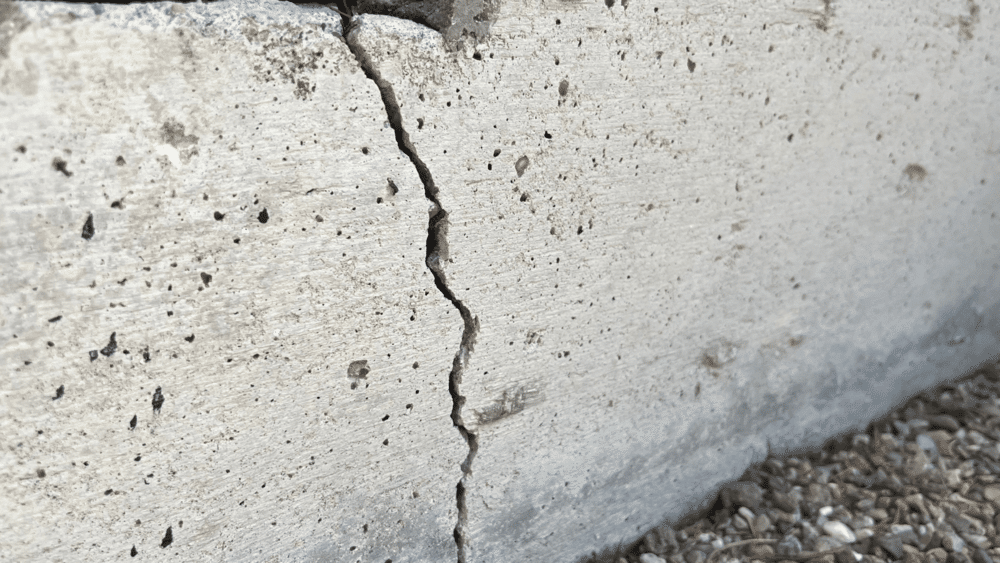
Two separate things cause cracking, and it helps to keep them straight.
The first is normal material behavior. Concrete shrinks slightly as it cures, and that shrinkage produces thin cracks in slabs and driveways within the first year or two. Brick expands and contracts with temperature. Drywall joints move a little as a house settles into place. None of this involves your foundation failing.
The second is soil movement, and this is the North Texas specialty. The metroplex sits on expansive clay that swells when wet and shrinks when dry. Through a Texas year, that soil lifts and drops the ground under your house repeatedly. When it moves unevenly, meaning one corner settles while another stays put, the structure above has to absorb that stress. Cracks are where it gives.
So the useful question is not “is there a crack.” It is “does this crack look like material behavior or like the house is being pulled apart.”
Four Things That Matter More Than Crack Type
Before getting into specific patterns, these four factors tell you more than the shape alone.
Width. A rough rule: anything you could not slide a dime into, under about 1/16 of an inch, is usually cosmetic. Between 1/8 and 1/4 inch is worth monitoring. A quarter inch or wider in brick veneer or a foundation wall deserves a professional look.
Direction. Vertical and diagonal cracks are generally less serious than horizontal ones. More on why below.
Change over time. A crack that has looked the same for five years is telling you the movement already happened and stopped. A crack that has visibly widened since last spring is telling you it is ongoing. This is the single most useful piece of information you can gather, and it costs nothing but patience.
What else is happening? One crack by itself means much less than one crack plus three sticking doors plus a sloping hallway. Structural movement rarely shows up alone.
Vertical Cracks
Where you see them: brick and mortar, drywall, poured concrete, garage slabs.
What they usually mean: vertical cracks are the most common and generally the least alarming. In concrete they are often shrinkage from curing. In drywall they frequently appear along seams where two sheets meet. In brick they can follow a mortar line for a few courses and stop.
When to pay attention: if a vertical crack is wider at the top than at the bottom, or wider at the bottom than the top, that taper is meaningful. It suggests one part of the house is moving relative to another rather than material simply shrinking. A vertical crack wider than a quarter inch, or one that runs the full height of a wall, is also worth evaluating.
Diagonal Cracks
Where you see them: drywall, especially running up and away from the corners of doors and windows. Also in brick.
What they usually mean: diagonal cracks, particularly ones running at roughly 45 degrees, typically indicate differential settlement. In plain terms, one section of the foundation has dropped more than the section next to it, and the wall is tearing along the line of that stress.
Door and window corners are where this shows up first because openings are the weakest points in a wall. That is simple physics, not necessarily a sign of disaster.
When to pay attention: short, thin diagonal cracks above a door that have not changed in years are usually old news. Multiple diagonal cracks appearing across different rooms, cracks that keep returning after repair, or cracks growing wider each season point to active movement worth investigating.
Stair Step Cracks in Brick
Where you see them: exterior brick walls, following the mortar joints in a stepped pattern that climbs the wall like a staircase.
What they usually mean: stair step cracks in brick are the classic signature of foundation settlement in a Texas home. Brick itself is strong, so when the ground beneath shifts, the wall gives way along the mortar, which is the weaker material. The stepping pattern traces the path of least resistance.
These are worth taking seriously, though not every one signals a structural problem. Stair step cracks in brick homes across Texas are common enough that a few hairline steps in one small area of a wall may be old, minor settlement that has long since stabilized. Our page on brick cracks and foundation damage covers this in more depth.
When to pay attention: the crack is wider than a quarter inch, it runs a long stretch of wall, one side of the crack has shifted out of plane with the other so the brick no longer lines up flat, or you can see it from across the yard. Also watch for stairs stepping near the corners of the house, since corners tend to move first.
Horizontal Cracks
Where you see them: foundation walls, brick, and occasionally in a long straight line through drywall.
What they usually mean: this is the one crack type that deserves prompt attention regardless of width. A horizontal foundation crack generally indicates lateral pressure, meaning something is pushing sideways against the structure rather than the structure simply settling downward. In North Texas that is often saturated clay expanding against a wall, or significant moisture problems under the slab.
When to pay attention: essentially always. A horizontal crack in a foundation wall, especially one accompanied by any bowing or bulging, should be looked at by a professional rather than monitored casually. This is not a reason to panic, but it is a reason to make the call rather than wait a season.
Slab and Concrete Floor Cracks
Where you see them: garage floors, exposed slab edges, under flooring.
What they usually mean: thin, random hairline cracks in a slab are extremely common and usually the result of concrete curing. Most homes have them.
When to pay attention: the important detail is elevation. Run your hand or a straightedge across the crack. If the concrete on one side sits noticeably lower than the other, that is differential movement, not curing shrinkage. Cracks wider than a quarter inch, cracks that run the length of the slab, or cracks that appear alongside floor sloping warrant an inspection of your slab foundation.
Drywall Cracks Foundation Movement
Interior cracks are often the first thing homeowners notice, since you live with these walls daily. The question we hear most is whether drywall cracks mean a foundation problem, and the answer depends almost entirely on where they sit and whether they keep coming back.
Hairline cracks along drywall seams, nail pops, and small cracks above doorways in the first couple of years after construction are usually normal. Cracks that run from a ceiling down a wall and continue onto the adjoining wall are a different matter, as are cracks that reopen every time you patch them. That repetition means the underlying movement never stopped.
Gaps opening between crown molding and the ceiling, or between baseboards and the floor, belong in the same category. They indicate the structure is pulling apart rather than the drywall simply settling.
The Warning Signs That Usually Travel With Serious Cracks
A crack that matters is rarely by itself. If you are seeing several of these together, the picture is much clearer:
- Doors and windows sticking, or no longer latching properly
- Visible gaps between the top of a door and its frame
- Floors that slope, dip or feel uneven, common in pier and beam homes
- Soil pulled away from the perimeter of the house leaving a visible gap
- Exterior trim, porch or steps separating from the main structure
- Nails popping out of drywall across multiple walls
- Chimney leaning or separating from the house
- Countertops or shelves that no longer read level
Our full list of the signs of foundation issues goes through what each of these indicates.
How to Monitor a Crack Properly
If you have decided a crack is worth watching rather than acting on, do it in a way that actually produces useful information.
- Mark the ends. Draw a light pencil line across each end of the crack and write the date next to it.
- Measure the width. Use a ruler or a cheap crack gauge from a hardware store. Write the number down.
- Photograph it. Include a coin or tape measure in the frame for scale.
- Repeat seasonally. Check in spring and again at the end of summer. North Texas soil moves most between a wet spring and a dry August, so those two readings tell you the most.
If the crack has not moved past your pencil marks after a full year, you are almost certainly looking at settled, historic movement. If it has grown, you now have documented evidence, which is genuinely useful during an inspection and later if you sell the house.
Why Patching Alone Does Not Solve It
Filling a crack with caulk or mortar hides the symptom. If the soil under the house is still moving, the patch will crack again, usually within a year, often in the same place. This is why drywall cracks that point to a foundation problem keep reappearing no matter how many times you mud and repaint them.
That does not mean cosmetic repair is wrong. Once the underlying movement has been addressed, patching and repainting is exactly the right final step. The order matters: stabilize first, then cosmetics. Our overview of foundation settlement explains how movement progresses when the cause is left alone.
When to Stop Monitoring and Make the Call
Reach out to a professional if any of the following apply:
- Any horizontal foundation crack, at any width
- Cracks wider than a quarter inch in brick or concrete
- Stair step cracks in brick where the wall has shifted out of alignment
- Cracks that have measurably widened over a season
- Cracks appearing alongside sticking doors, sloping floors or separating trim
- Cracks that keep returning after repair
- You are buying or selling and want documentation before it becomes a negotiation
An evaluation is not a commitment to repair. Often the honest answer is that a house has settled, it stopped years ago, and nothing needs doing.

Get a Straight Answer About Your Cracks
If you have been looking at a crack and wondering whether it means anything, you do not have to keep guessing. Schedule a free estimate with HD Foundations and we will tell you what we actually see, including if the answer is that your home is fine.
Our inspections take under an hour and cost nothing. Any repair work we do carries a lifetime transferable warranty, which transfers to the next owner if you sell.
Call 817-226-7221 or request an evaluation online. We serve homeowners throughout the DFW metroplex, including Dallas, Fort Worth, Arlington, Irving, Plano, Frisco and Mansfield.