
When concrete slabs sink, crack, or become uneven — whether it’s a driveway, sidewalk, patio, or the slab beneath your home — there are two common methods used to lift and stabilize them without full replacement: mudjacking and polyurethane foam lifting.
Both methods accomplish the same basic goal: fill the void beneath sunken concrete and raise it back to its original position. But they work differently, cost differently, and suit different situations. Understanding which one is appropriate for your specific problem can save you time, money, and the frustration of a repair that doesn’t last.
This guide explains how each method works, where each one excels, where each one falls short, and how to decide which is right for your situation.
What Is Mudjacking?
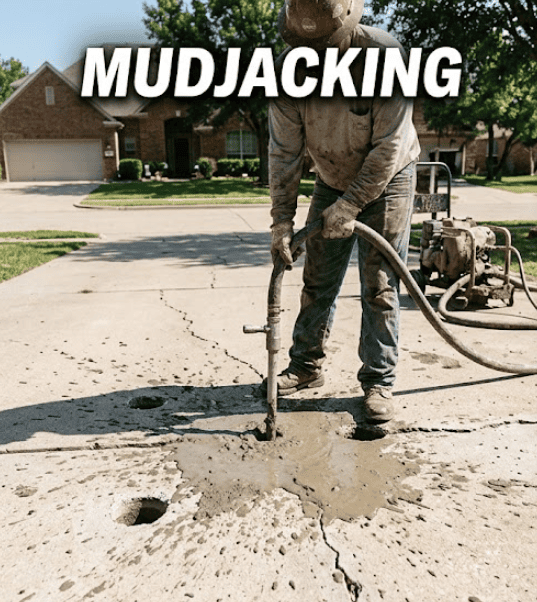
Mudjacking — also called slabjacking or pressure grouting — is the older of the two methods and has been used for decades. The process involves drilling a series of holes (typically 1.5 to 2 inches in diameter) through the sunken concrete slab, then pumping a slurry mixture — usually a combination of water, soil, sand, and cement — beneath the slab under pressure.
As the slurry fills the void and builds up beneath the slab, it lifts the concrete back toward its original position. Once the desired level is reached, the drill holes are patched and the surface is ready for use within 24–48 hours.
What mudjacking is commonly used for:
- Sunken driveways and sidewalks
- Settled patio slabs
- Uneven pool decks
- Steps and stoops that have dropped
- Interior concrete floors in garages or basements
What Is Polyurethane Foam Lifting?
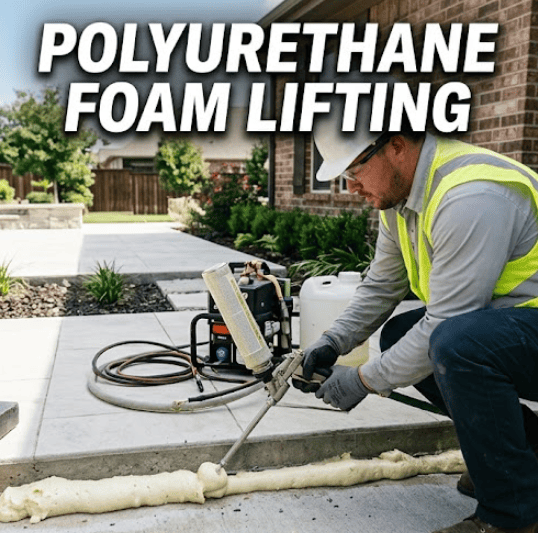
Polyurethane foam lifting — sometimes called polyjacking, foam jacking, or foam injection — is a newer approach that uses an expanding two-part polyurethane foam instead of a slurry mixture. Small holes (about the diameter of a penny — roughly 5/8 inch) are drilled through the slab, and the foam is injected beneath it.
The foam expands rapidly, filling voids and lifting the slab within minutes. It then cures into a rigid, lightweight, water-resistant material. Because it sets so quickly, the surface is typically ready for foot traffic within 15 minutes and vehicle traffic within an hour.
What polyurethane foam lifting is commonly used for:
- The same applications as mudjacking
- Situations where minimal disruption is critical
- Areas where load-bearing stability and moisture resistance matter most
- Tighter spaces where larger drilling equipment is difficult to maneuver
How They Compare: A Detailed Breakdown
Hole Size
This is one of the most immediately noticeable differences. Mudjacking requires holes roughly 1.5–2 inches in diameter — visible and harder to conceal after patching. Polyurethane foam uses holes closer to 5/8 inch, which patch almost invisibly.
For decorative concrete, colored slabs, or any surface where appearance matters, polyurethane foam leaves a much cleaner result.
Weight of the Fill Material
The slurry used in mudjacking is heavy — it weighs roughly 100–150 pounds per cubic foot. That weight is sitting permanently beneath your slab, adding load to whatever soil is underneath.
Polyurethane foam, by contrast, weighs about 2–4 pounds per cubic foot. This matters in situations where the soil beneath is already compromised or weak — adding significant weight on top of unstable soil can cause the problem to recur. Foam’s lighter footprint puts far less stress on the underlying ground.
Cure and Ready Time
Mudjacking slurry typically takes 24–48 hours to cure fully before the repaired area should be subjected to vehicle traffic. Polyurethane foam cures within minutes — most areas are walkable in 15 minutes and ready for vehicles within an hour.
If you need a driveway, parking lot, or access point back in service quickly, foam has a clear advantage.
Longevity and Stability
Both methods can provide long-lasting results when the underlying cause of the sinking has been addressed — but they behave differently over time.
Mudjacking slurry is porous and can absorb water over time. In areas with significant moisture fluctuation (which is most of North Texas), this can cause the fill material itself to erode, wash away, or contribute to further settlement. Polyurethane foam is waterproof and won’t erode, dissolve, or compact over time. It maintains its volume and rigidity indefinitely once cured.
For long-term durability — especially in climates with significant rainfall and moisture variation like DFW — polyurethane foam generally holds up better.
Cost
Mudjacking is typically less expensive upfront — often by 25–50% compared to polyurethane foam for the same job. However, the total cost picture is more nuanced:
- If mudjacking needs to be redone in a few years because the fill eroded, the lifetime cost may exceed foam’s higher initial price
- Polyurethane foam’s faster cure time reduces labor hours, which partially offsets the material cost difference
- For large surface areas, the cost gap narrows
For homeowners focused purely on the lowest immediate cost, mudjacking has the advantage. For those prioritizing durability and total value over time, foam often makes more financial sense.
Environmental Footprint
Mudjacking uses natural materials — soil, sand, water, and cement — which some consider a more environmentally neutral choice. Polyurethane foam is a synthetic material derived from petrochemicals. However, because foam lasts longer and requires less future intervention, the net environmental impact over a structure’s lifespan is debatable.
What These Methods Are — And Aren’t — Used For
It’s worth being clear about the scope of concrete lifting versus structural foundation repair, because they’re related but distinct.
Mudjacking and polyurethane foam lifting are primarily used to raise and stabilize exterior flatwork — driveways, walkways, patios, pool decks, and garage floors — and some interior concrete surfaces. They fill voids and restore level surfaces.
Structural foundation repair — the kind needed when a home’s slab or pier and beam foundation is settling, cracking, or failing — typically requires a different approach entirely. The foundation repair process for a home’s structural foundation usually involves installing concrete or steel piers driven down to stable soil or bedrock, which provides permanent support that surface-level lifting methods can’t replicate.
Polyurethane foam can be used in some foundation applications — particularly to fill voids beneath interior slabs or as part of a broader repair strategy — but it is not a standalone solution for significant structural foundation movement. If you’re seeing signs of foundation problems such as widening cracks, sticking doors, or sloping floors throughout your home, a professional foundation evaluation is the right first step — not a concrete lifting treatment.
Which Method Should You Choose?

Here’s a practical decision framework:
Choose mudjacking if:
- Budget is your primary concern and you’re working with a large surface area
- The application is a low-traffic area where cure time isn’t critical
- The underlying soil is stable and moisture intrusion isn’t a major concern
- You’re comfortable with the possibility of retreating the area in the future
Choose polyurethane foam if:
- You need the area back in service quickly
- Appearance matters and you want minimal visible patching
- The area is subject to moisture or poor drainage
- The underlying soil is weak or compromised and you want to minimize added load
- You want the longest possible lifespan from a single treatment
- You’re treating a smaller, more precise area
Get a professional evaluation if:
- The sinking involves your home’s structural foundation rather than exterior flatwork
- Cracks are widening, floors are uneven throughout the home, or doors and windows are sticking
- You’re unsure whether surface lifting or structural repair is the right solution
The North Texas Factor
Both methods are used throughout the DFW area, but the local soil conditions are worth factoring into your decision. North Texas’s expansive clay soil absorbs moisture and swells, then shrinks and contracts during dry periods. This cycle is relentless and puts ongoing stress on anything sitting on or in the ground.
Because mudjacking slurry can absorb moisture and is subject to erosion from this cycle, polyurethane foam tends to perform more consistently in DFW’s climate over the long term. That said, neither method eliminates the underlying cause of slab movement — if drainage issues or soil instability are driving the problem, those need to be addressed alongside any lifting treatment.
The Bottom Line
Mudjacking and polyurethane foam lifting are both legitimate, proven methods for raising sunken concrete. Mudjacking costs less upfront and uses natural materials. Polyurethane foam cures faster, leaves smaller holes, weighs less, and holds up better against moisture over time.
For most applications in North Texas — particularly where moisture, appearance, or long-term durability matter — polyurethane foam has meaningful advantages. For large areas where budget is the primary driver, mudjacking remains a reasonable choice.
What neither method replaces is a proper structural foundation repair when the home itself is moving. If you’re not sure which situation you’re dealing with, HD Foundations can help you figure it out. We’ve been serving the DFW area for over 17 years and offer free estimates with no obligation. Get a clear answer before committing to any treatment.
Frequently Asked Questions
Is mudjacking the same as polyurethane foam lifting?
No — they achieve the same goal (raising sunken concrete) but use different materials and methods. Mudjacking uses a heavy cement-soil slurry pumped through larger holes. Polyurethane foam uses a lightweight expanding foam injected through much smaller holes.
How long does mudjacking last?
Results vary, but mudjacking typically lasts 5–10 years depending on soil conditions, moisture levels, and the quality of the original repair. In North Texas’s clay soil environment, the timeline can be shorter if drainage issues aren’t also addressed.
How long does polyurethane foam lifting last?
Polyurethane foam itself doesn’t degrade, erode, or compress once cured. In stable conditions it can last the life of the slab. The slab may still move if underlying soil conditions change significantly, but the foam material itself remains intact.
Can foam lifting fix my home’s foundation?
Polyurethane foam can fill voids beneath interior slabs and plays a role in some repair strategies, but it is not a standalone solution for structural foundation movement. Homes that are actively settling, cracking, or shifting require pier-based structural repair. A professional evaluation will clarify which applies to your situation.
How much does mudjacking cost vs. polyurethane foam?
Mudjacking generally runs 25–50% less than polyurethane foam for the same job. Both are significantly less expensive than full slab replacement. Exact pricing depends on the size of the area, accessibility, and severity of the sinking.Request a free estimate to get an accurate number for your specific situation.
Is polyurethane foam safe under concrete?
Yes. The polyurethane foam used in concrete lifting is specifically formulated for subsurface use, is chemically stable once cured, and does not leach harmful materials into the soil.